The Healing Power of Tuning Forks: How Frequency Supports Balance and Well-Being
The Healing Power of Tuning Forks: How Frequency Supports Balance and Well-Being
In a world that moves faster every day, many people are feeling the effects of chronic stress, energetic overload, and nervous system imbalance. As more individuals seek gentle, non-invasive ways to restore harmony in their bodies and minds, ancient sound-based practices arere-emerging with renewed interest. One of the simplest yet most powerful tools in this space is the tuning fork.
Used for centuries in music, and later adapted for wellness practices, tuning forks offer a unique way to introduce calming frequencies into the body. While modern science continues to explore how vibration affects human physiology, many people already experience tuning forks as deeply relaxing, grounding, and supportive for emotional and energetic balance.
At Regeneration Station, we view tuning forks as a beautiful bridge between ancient wisdom and modern frequency-based wellness.
What Are Tuning Forks?
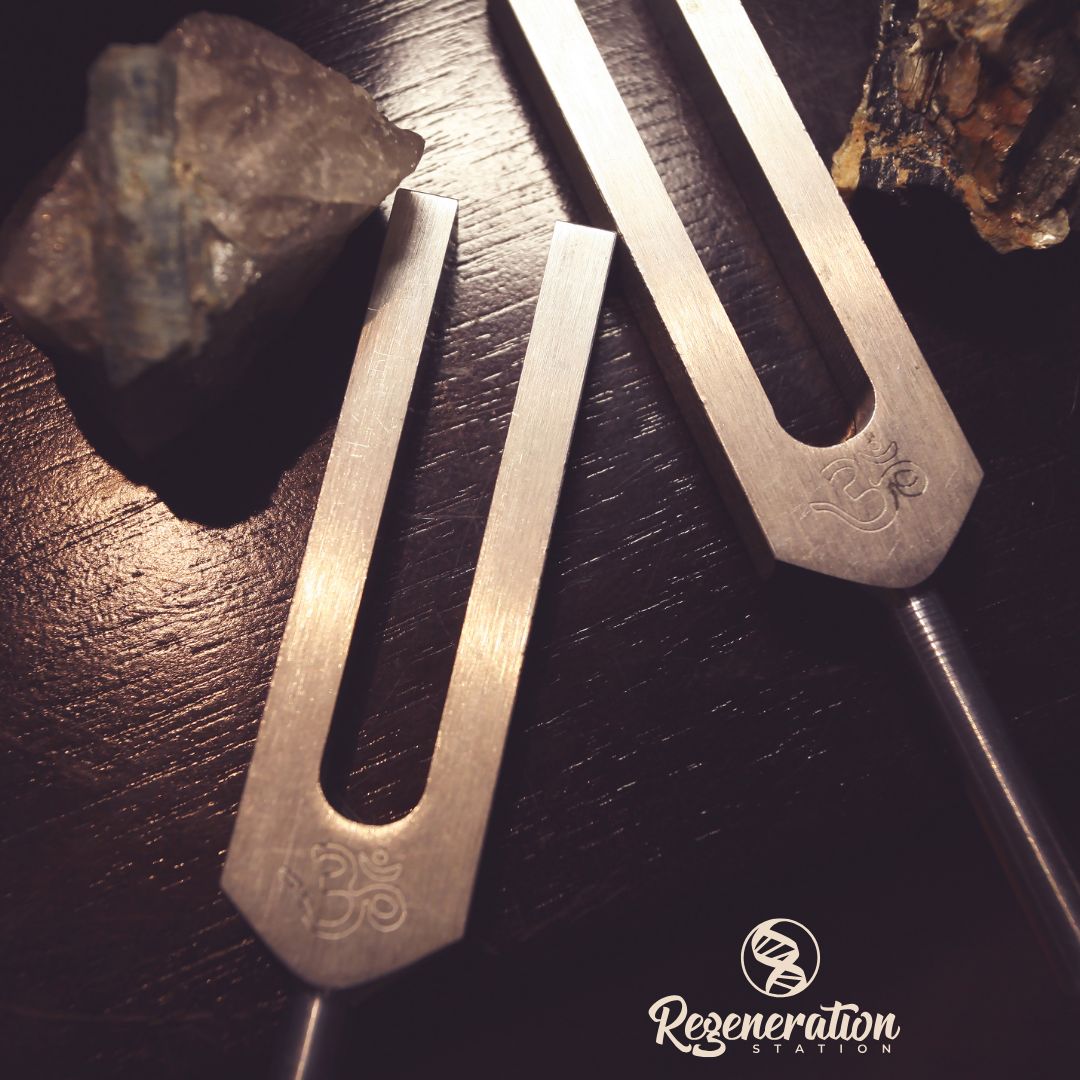
A tuning fork is a precisely calibrated metal instrument designed to emit a specific frequency when gently struck. Once activated, the fork produces both an audible sound and a subtle vibration that can be felt through the air or directly on the body.
Unlike music, which combines many frequencies at once, tuning forks produce a single, consistent tone. This purity allows the body and nervous system to interact with vibration in a more focused and intentional way.
Each tuning fork is tuned to a specific frequency, such as:
128 Hz– often used for deep relaxation
136.1 Hz (Om frequency)– associated with grounding and balance
174 Hz, 285 Hz, 528 Hz– commonly used in sound wellness practices
Weighted tuning forks– designed to transmit vibration more deeply through tissues
The Body as a Vibrational System
At its most fundamental level, the human body operates through vibration. Every cell communicates through electrical impulses, and our nervous system relies entirely on frequency-based signals.
From heartbeat rhythms to brainwaves, the body functions as a complex orchestra of timing and resonance. When stress, trauma, illness, or emotional overload occurs, these rhythms can become disorganized.
Tuning forks introduce coherent, stable frequencies that the body may naturally entrain to — a phenomenon known as resonance.
Much like how one tuning fork can cause another nearby fork to vibrate without being touched, the body often responds to consistent frequencies by gently recalibrating its own rhythms.
How Tuning Forks Are Used in Wellness Sessions
During a tuning fork session, the practitioner activates the fork and applies it in one or more ways:
Placed near the ears to engage the auditory system
Hovered within the biofield surrounding the body
Gently applied to muscles, joints, or bones (with weighted forks)
Used along meridian or chakra pathways
Combined with breathwork or meditation
Clients often remain fully clothed, resting comfortably while the vibrations move through the body.
Many describe the experience as:
Deeply calming
Grounding
Meditative
Emotionally soothing
Supportive for nervous system regulation
Sessions are quiet, gentle, and suitable for individuals who may not tolerate intense bodywork or stimulation.
Why Sound and Vibration Feel So Powerful
Sound reaches the body through more than just the ears.
Approximately 70% of the human body is water, and water is an exceptional conductor of vibration. When sound waves move through tissue and fluids, they create subtle oscillations that may influence relaxation responses and sensory processing.
Research in fields such as vibroacoustic therapy, psychoacoustics, and neurology continues to explore how sound frequencies interact with:
Brainwave states
Heart rate variability
Muscle tension
Stress perception
Emotional regulation
While tuning forks are not intended to diagnose or treat medical conditions, their ability to promote calm and coherence is widely recognized.
Emotional and Energetic Support
Many people carry emotional stress in the body long after the mind has moved on. Sound offers a nonverbal pathway to release tension that may not be accessible through conversation alone.
Tuning forks are often incorporated into practices intended to support:
Emotional grounding
Relaxation during transitions or life changes
Stress decompression
Meditative awareness
Mind–body reconnection
Because vibration is felt rather than analyzed, the experience can bypass mental resistance and invite the body into a parasympathetic (“rest and restore”) state.
Tuning Forks and the Nervous System
One of the most profound effects clients report is a sense of the nervous system settling.
Gentle rhythmic frequencies may help the body shift from a constant “fight-or-flight” mode into a calmer baseline. This is especially important in today’s world, where overstimulation from screens, noise, and chronic stress is common.
When the nervous system feels safe, the body naturally moves toward:
Improved rest
Deeper breathing
Muscle relaxation
Clearer mental focus
Enhanced sense of well-being
This is why tuning forks are often used alongside meditation, breathwork, light therapy, or energy-based wellness technologies.
Ancient Wisdom Meets Modern Frequency Wellness
Cultures throughout history have recognized the power of sound:
Tibetan singing bowls
Gregorian chants
Indigenous drumming
Mantras and toning
Bells and harmonic instruments
Tuning forks represent a modern expression of this ancient understanding — precise, measurable frequencies delivered in a simple, accessible way.
As interest grows in frequency medicine, biofield science, and vibrational wellness, tuning forks continue to gain recognition as a foundational tool.
Who May Enjoy Tuning Fork Sessions?
Tuning fork experiences are gentle and adaptable, making them popular among people who:
Prefer non-invasive wellness approaches
Are sensitive to touch or massage
Feel mentally overstimulated
Seek deeper meditation support
Want emotional or energetic balance
Are exploring frequency-based wellness
Many clients enjoy tuning forks on their own or paired with other modalities such as:
Light System sessions
Quantum energy beds
Breathwork
Sound baths
Meditation or intention setting
A Gentle Invitation to Restore Harmony
Healing does not always require force. Sometimes, the body simply needs the right environment — one that feels safe, coherent, and supportive.
Tuning forks offer a reminder that balance can be invited rather than demanded. Through vibration, rhythm, and resonance, the body is given an opportunity to remember its natural state of harmony.
At Regeneration Station, we believe wellness is not about fixing what’s broken —it’s about supporting the body as it reconnects with its innate intelligence.
Sound, after all, is not something we merely hear, it is something we feel.
With love and gratitude, we rise.
